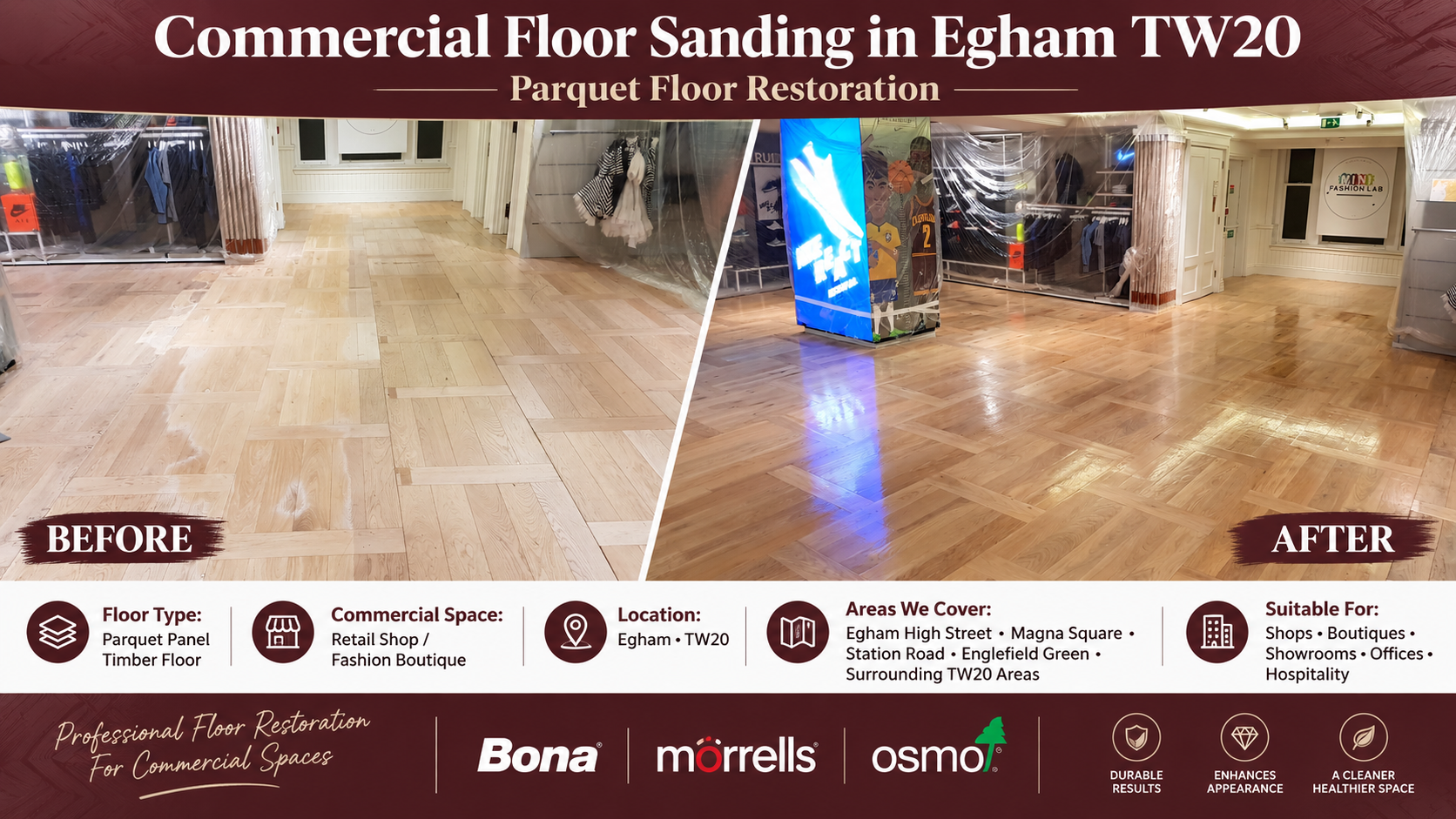
Commercial Floor Sanding in Egham TW20
Commercial floor sanding in Egham TW20 is rarely just a matter of taking a belt sander across a tired timber floor. In offices, shops, restaurants, schools, hotels, clinics, gyms and working industrial premises, the floor has normally failed for a reason: worn lacquer, grit abrasion, chair-castor damage, cleaning chemical attack, moisture movement, loose parquet or years of patch repairs carried out without considering the original timber.
We restore commercial timber floors across Egham, including premises around Egham High Street, Magna Square, Station Road, Englefield Green and the wider TW20 area. The town centre contains a mixture of historic shopfront properties, narrow older commercial plots and later retail and office buildings, so the right approach can vary considerably from one unit to the next.
Our work covers full Commercial Floor Restoration in Egham, planned Commercial Floor maintenance in Egham and specification-led Commercial Floor Polishing in Egham. The aim is not simply to make the timber look cleaner; it is to return the floor to a stable, hygienic and fit-for-purpose condition without creating unnecessary disruption to the building.
Commercial Timber Floors in Egham Need More Than Domestic Sanding
A timber floor in a private house might see shoes, furniture and normal household cleaning. A commercial floor can see thousands of footsteps, wet entrance traffic, wheeled office chairs, pallet movements, gym equipment, bar stools, food spillages, disinfectant, coffee, grease, grit and repeated machine cleaning.
That difference matters. A domestic single-component lacquer that performs adequately in a bedroom can wear through rapidly in a restaurant aisle, school corridor or serviced office reception. Likewise, putting polish over a chemically contaminated or partially delaminated coating simply seals the problem underneath.
We assess the floor as a working surface first. That means identifying the timber, checking the existing coating, looking for subfloor movement and moisture, and establishing what level of slip resistance, chemical resistance and curing time the premises actually require.
- Open board gaps: collect grit, food debris and cleaning moisture and can become hygiene traps in cafés, pubs, clinics and education buildings.
- Loose parquet or blocks: movement under foot can fracture surrounding joints and cause localised coating failure.
- Moisture ingress: may cause cupping, crowning, adhesive failure or dark staining, particularly where timber sits over older ground floors or close to entrances.
- Worn finish: once traffic reaches bare timber, water and contamination penetrate more rapidly and simple re-coating becomes less reliable.
- Unsuitable polish: repeated use of silicone-rich or metallised maintenance products can interfere with later lacquer adhesion.
- Slip risk: restaurants, hospitality premises, gyms, schools and public-facing buildings may require the floor finish to be considered against the site’s slip-risk assessment and, where specified, BS 7976-2 pendulum testing.
- Previous poor sanding: dish marks, chatter, edge-sander trenches and over-sanded tongues are common on floors that have already been aggressively refurbished.
Floor Types We Restore in Commercial Premises
Before abrasive work starts, we identify what is actually on the floor. Quartersawn oak behaves differently from pitch pine, teak, beech or modern engineered oak, and old parquet blocks cannot be treated in the same manner as a thick structural board.
Older Egham and Englefield Green premises can contain timber installed during several different periods, sometimes within the same building. Victorian and Edwardian conversions may have pitch-pine boards in secondary rooms, oak strip or parquet in front-of-house areas, and later repairs carried out with completely different species.
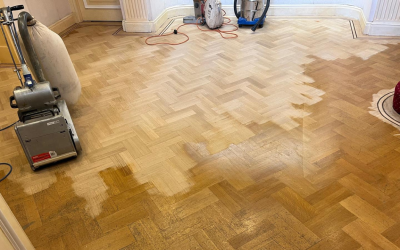
We regularly deal with solid strip flooring, parquet blocks, herringbone, mosaic parquet, engineered timber, pine boards and hardwood floors that have previously been stained, lacquered, waxed or oiled. Where timber thickness is limited, we adjust the abrasive sequence rather than removing material merely to achieve a uniform colour.
Step-by-Step Commercial Floor Restoration Process
Step 1: Subfloor Audit & Moisture Testing
We start with the substrate and the operating conditions of the building. Loose boards, drummy parquet, deflection, damaged thresholds, expansion issues and evidence of historic water penetration are recorded before sanding is priced as a finished specification.
Where moisture is suspected, hygrometer checks are carried out rather than assuming dark timber is simply old staining. There is little value applying a high-performance lacquer to timber that is still receiving moisture from below or from an unresolved plumbing, entrance or cleaning problem.
Commercial sites are also assessed for access, extraction routes, fire exits, alarm systems, adjacent occupied areas and material storage. For larger or managed premises we can work from RAMS documentation, site induction requirements and the principal contractor or facilities manager’s permit system.
Step 2: Timber Repairs, Re-bonding & Resin Gap-Filling
Loose parquet is lifted selectively where practical, old brittle adhesive is removed and suitable blocks are re-bonded. Depending on the substrate, timber type and service conditions, this may include a silane-based flexible parquet adhesive, particularly where a degree of elastic movement accommodation is preferable to a rigid bond.
Damaged boards can be repaired or replaced with timber selected to suit the existing floor as closely as reasonably possible. We pay attention to dimensions, grain orientation and species rather than fitting a visually obvious patch and expecting stain to disguise it.
For appropriate board and parquet floors, fine sanding dust can be combined with a compatible resin binder to produce a resin-slurry gap fill. This is useful for stable fine gaps, but it is not treated as a cure for major structural movement; excessively wide or actively moving joints need mechanical repair or timber fillets instead.
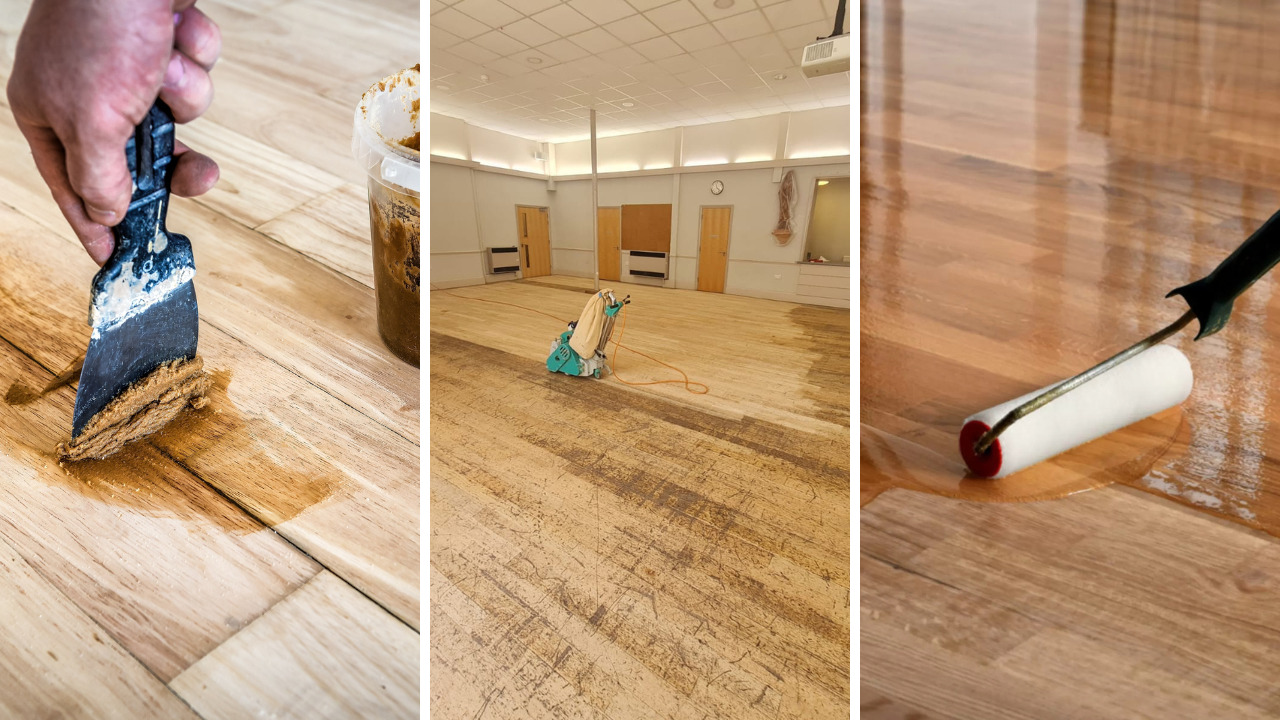
Step 3: HEPA Dust-Controlled Sanding & Surface Preparation
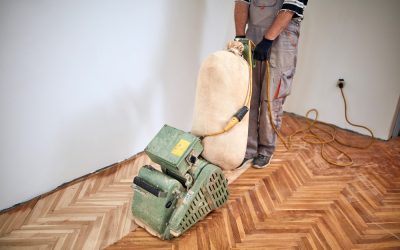
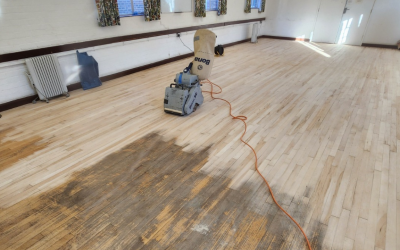
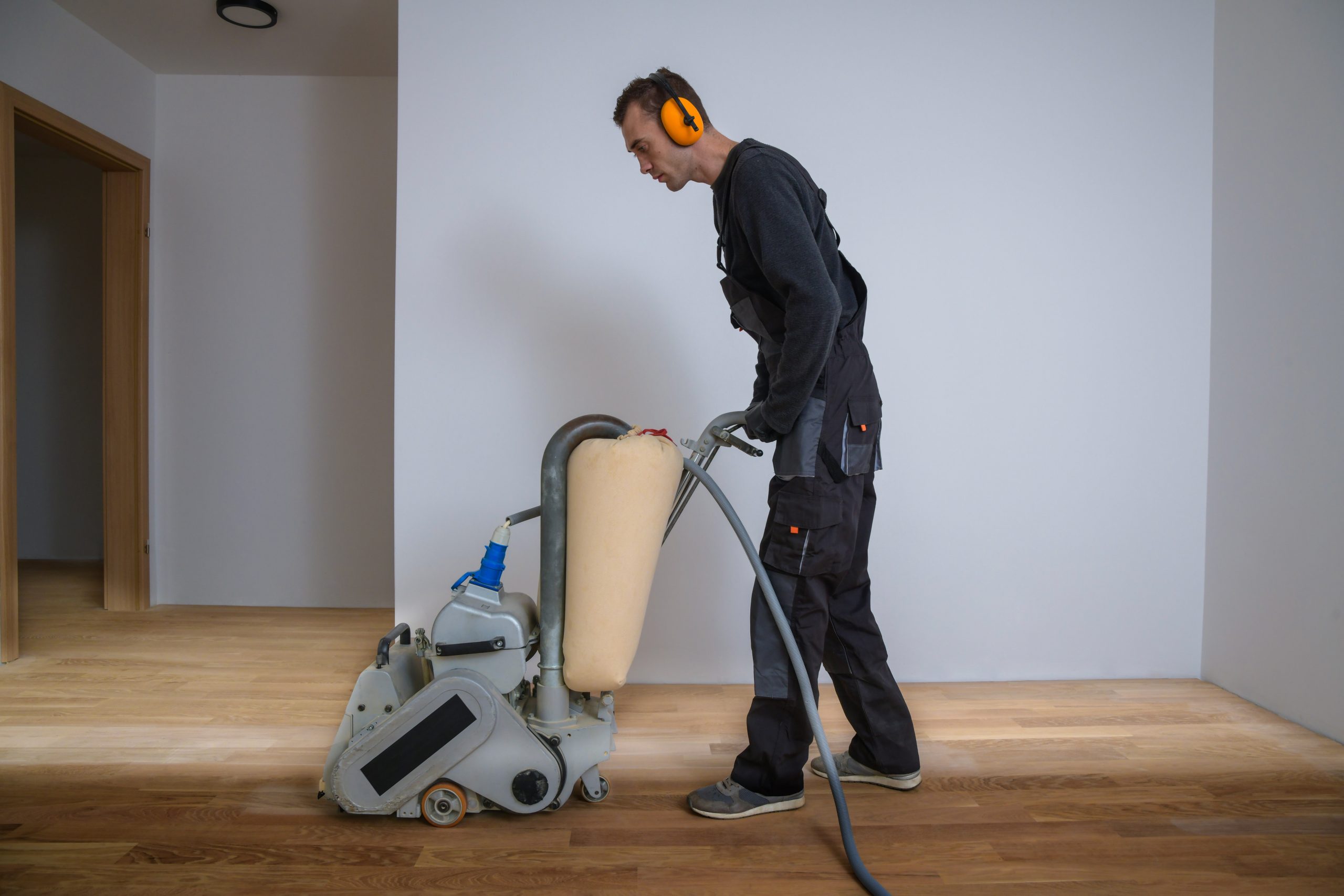
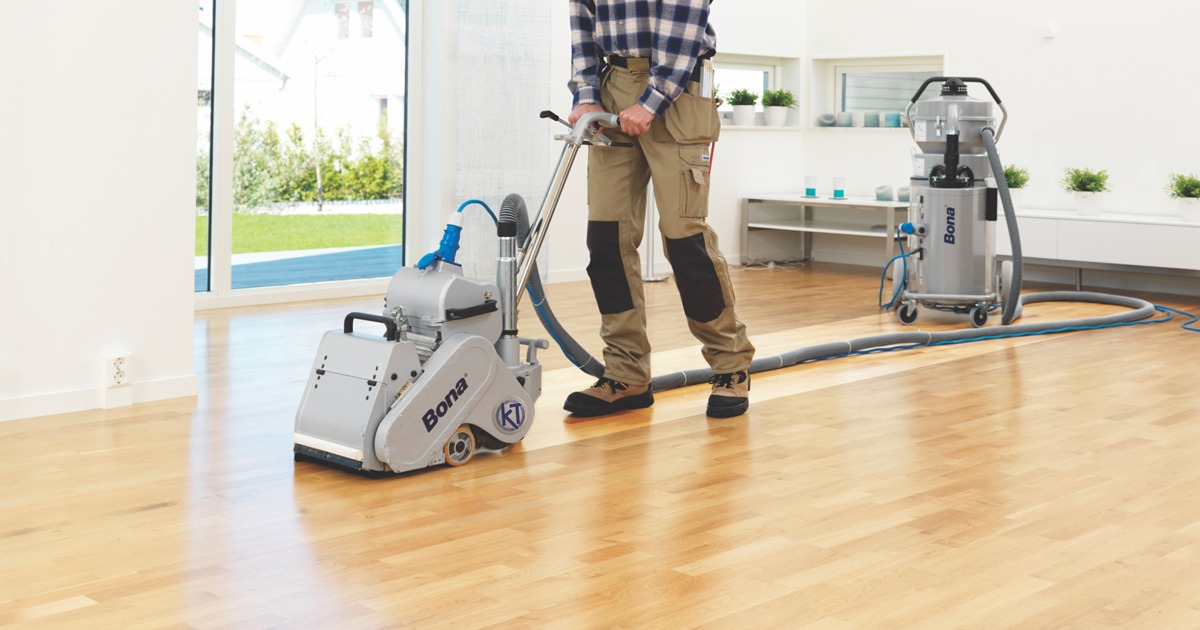
Heavy reduction work is carried out with professional belt sanding equipment such as the Lägler Hummel rather than lightweight DIY-style machines. Correctly set up, the Hummel provides controlled cutting across larger commercial areas while allowing the abrasive sequence to be matched to coating thickness, timber hardness and existing surface damage.
Edges, corners, radiator zones and restricted areas are treated separately so that the finished surface does not show a different scratch pattern around the perimeter. Intermediate sanding removes the previous grit pattern progressively instead of attempting to jump from a coarse cut directly to final finishing.
Dust control is planned as part of the job. Where the site specification requires enhanced containment, extraction can be configured with HEPA H14 filtration, alongside local collection at sanding equipment and detailed vacuuming before coating.
For clinics, offices, schools, hotels and active public buildings, that matters as much as appearance. Fine airborne wood dust must be controlled under the site’s COSHH arrangements, particularly when other trades, staff, stock, IT equipment or ventilation systems remain within the building.
Step 4: High-Traffic Finishes – 2K Lacquers, Hardwax Oils & Anti-Slip Systems
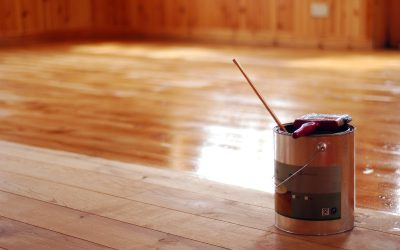
The coating is selected after considering traffic, cleaning regime, desired appearance and shutdown period. For demanding offices, education buildings, retail premises and hospitality floors, we commonly specify professional 2K waterborne polyurethane systems where their abrasion and chemical resistance suits the site.
A two-component lacquer uses a measured cross-linking catalyst or hardener rather than relying solely on evaporation. Once mixed, the product has a defined pot life, so batches have to be controlled carefully and applied within the manufacturer’s specified temperature, coverage and recoat conditions.
Hardwax oil remains useful where the client wants a lower-build, repairable surface and accepts the associated maintenance regime. It is not automatically the correct answer for every restaurant, gym or high-volume entrance; the operational cleaning programme must suit the finish.
Where slip risk is a material part of the brief, we can specify compatible anti-slip or higher-friction coating systems rather than improvising with generic additives. On public or managed sites, performance may need to be considered alongside BS 7976-2 pendulum slip-resistance testing and the site’s formal risk assessment.
We can also select primers, adhesives and coatings with recognised low-emission classifications where required by the project. For sensitive interiors, products carrying ratings such as EMICODE EC1 Plus may be appropriate, subject to the exact adhesive or system being specified.
Step 5: Aftercare & Commercial Floor Maintenance
A newly coated commercial timber floor can be damaged very quickly by the wrong cleaning product. Strong alkaline degreasers, excessive water, steam cleaning and inappropriate polish can soften, dull or contaminate an otherwise sound coating.
We provide practical aftercare guidance covering dry-soil removal, damp cleaning, furniture protection and planned re-coating. In heavily used premises, a scheduled maintenance coat before the timber is exposed is usually less disruptive and less expensive than repeatedly allowing the finish to wear back to bare wood.
For examples of completed work, visit our floor sanding gallery. If you are budgeting before a survey, our floor sanding prices page gives a useful starting point, although commercial quotations are based on access, floor condition, area, repairs, coating specification and working hours.
Commercial Floor Sanding for Egham Businesses & Public Buildings
Our commercial work is planned around what the building does during normal trading hours. A restaurant requiring tables back in position for service has a different programme from an office floor that can be divided into zones or a school hall available during a weekend or holiday period.
We work with private offices, coworking and serviced offices; shops, boutiques and showrooms; restaurants, cafés, pubs and takeaway premises; factories, workshops and manufacturing units; storage units, distribution centres and delivery depots; gyms, cinemas, studios and event venues.
We also work in hotels, hostels and serviced accommodation, clinics, dental practices and treatment rooms, as well as schools, colleges, universities, academies, churches, mosques and temples where access, safeguarding, public circulation and cleaning requirements often need to be agreed before machinery arrives.
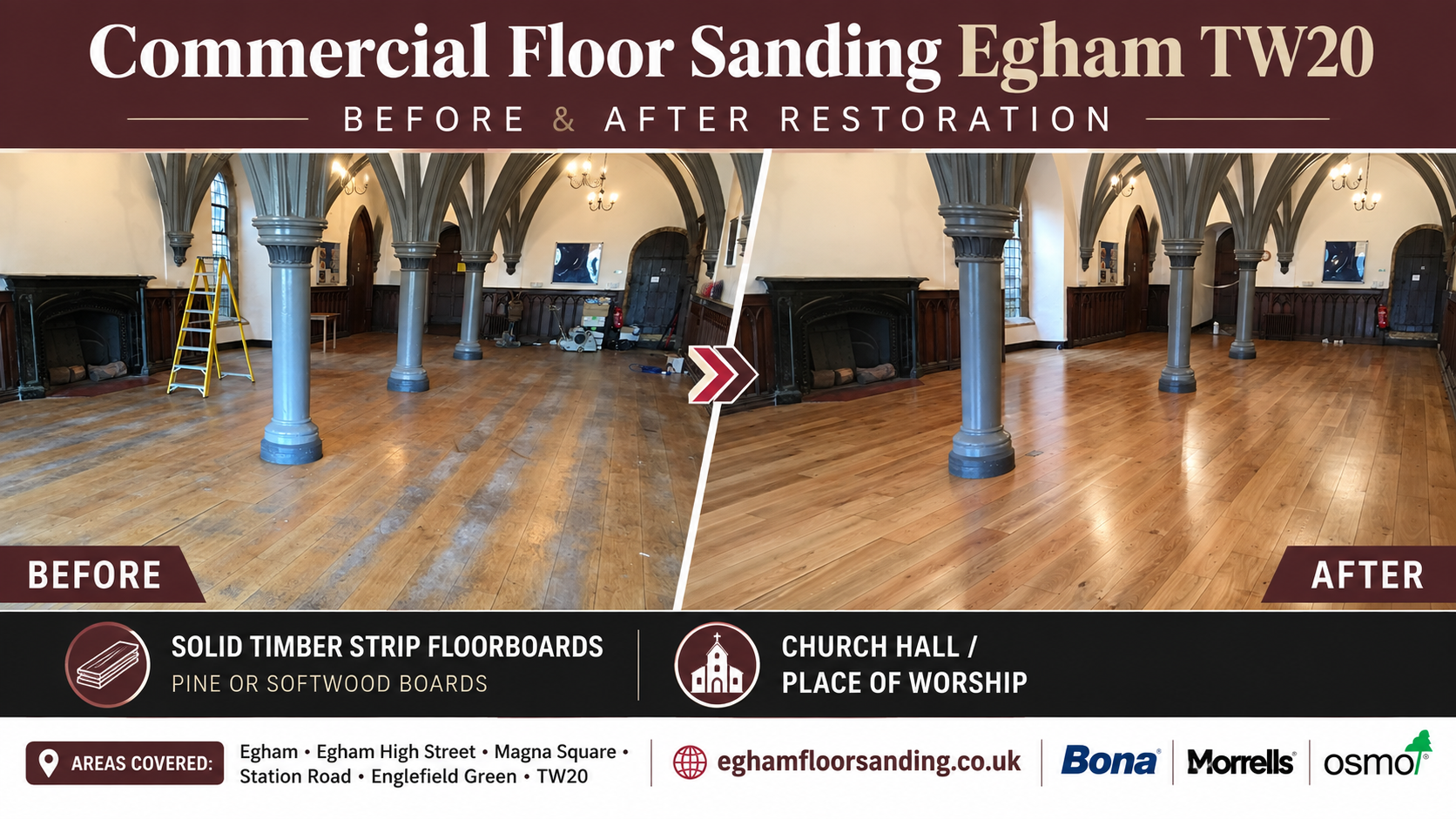
Working Around Your Trading Hours
Closing a commercial building for a week is often unrealistic. We therefore plan around handover zones, cure windows, access routes and the point at which the coating can tolerate controlled foot traffic.
Drying and full cure are not the same thing. A lacquer may be touch-dry or ready for careful foot traffic before it has reached full chemical and mechanical resistance, so furniture replacement, rugs, heavy equipment, intensive cleaning and wheeled loads must follow the coating manufacturer’s cure schedule.
| Working Pattern | Operational Benefit | Typical Facility Suitability |
|---|---|---|
| Overnight | Sanding and selected coating stages are completed outside customer or staff hours, with the area isolated for the required drying period. | Retail units, offices, restaurants, pubs, cafés, clinics and reception areas. |
| Weekend Phased | Allows larger zones to be completed between Friday shutdown and Monday reopening, subject to the chosen coating’s cure requirements. | Schools, colleges, offices, showrooms, surgeries, studios and managed commercial buildings. |
| Sectional | The floor is divided into controlled work zones so part of the premises can remain operational where safe access routes can be maintained. | Hotels, serviced offices, larger retail floors, corridors, event premises and multi-room sites. |
Floor Restoration in Egham High Street & Older Commercial Buildings
Egham High Street includes historic commercial properties alongside more recent redevelopment, with shops, cafés, offices and civic uses concentrated through the town centre. Older narrow-fronted premises can bring practical constraints such as restricted loading, occupied upper floors, limited rear access and floors that have been altered several times during the life of the building.
Properties close to the Egham Town Centre Conservation Area also deserve a measured approach. Where an original timber floor remains viable, controlled repair and conservative sanding can retain considerably more historic material than unnecessary replacement.
Around Englefield Green and the Royal Holloway area, commercial and institutional premises can also contain older timber installations alongside later extensions and repairs. We treat each surface according to its construction and service requirements rather than applying one standard sanding schedule across every room.
Health, Safety & Site Compliance
Commercial floor sanding creates risks that need managing: machinery, temporary electrical supplies, wood dust, coating products, noise, trip hazards, restricted access and partially finished surfaces. On managed projects these controls are documented before commencement rather than dealt with informally once work is under way.
RAMS can be provided for applicable commercial works, together with COSHH information for coatings, adhesives, fillers and cleaning products used on site. Where the contract requires it, operatives attend with relevant CSCS credentials and comply with site induction, PPE, access and permit requirements.
Pedestrian routes and drying areas are clearly controlled. In premises remaining partly open, we agree the work boundary with the facilities manager or responsible person before sanding begins so staff, customers and other trades are not routed through an active work zone.
Why Proper Specification Matters
One of the most expensive mistakes in commercial flooring is specifying the finish on appearance alone. A matt lacquer can look excellent on handover but still be wrong for a floor exposed to aggressive degreasing, rolling loads or wet entrance traffic.
The same applies to repairs. Filling a moving board gap with rigid filler, coating over silicone contamination or lacquering damp timber may produce a respectable photograph on completion but leaves a predictable failure mechanism underneath.
Our quotation identifies the intended repair method, sanding sequence and coating system as clearly as the initial survey allows. Where a hidden problem can only be confirmed after existing coatings or loose blocks are removed, it is raised before extra work proceeds.
Commercial Experience, Documented Scope & Clear Quotations
Commercial work needs more than a verbal estimate and an approximate start date. We can begin with site photographs, video, dimensions or floor plans, then arrange a physical survey where substrate condition, access, repairs or coating specification need to be confirmed.
Our commercial work is supported by appropriate liability insurance, and applicable projects can be staffed by CSCS-carded personnel. The quotation sets out the agreed scope so facilities managers, business owners, landlords and contractors can see what is included before work starts.
We also discuss realistic reopening periods. That includes when controlled foot traffic may resume, when furniture can be replaced and when the coating is expected to reach a more complete cure before heavier service.